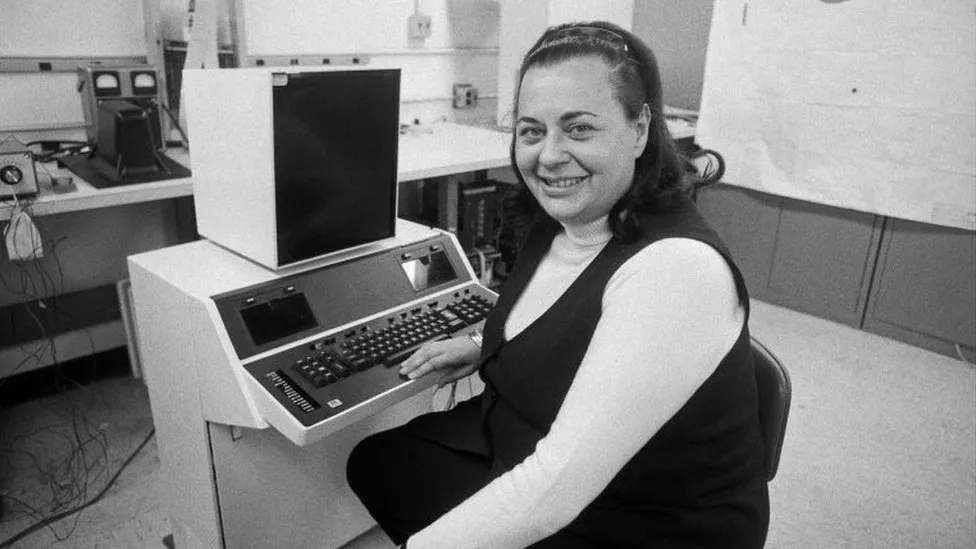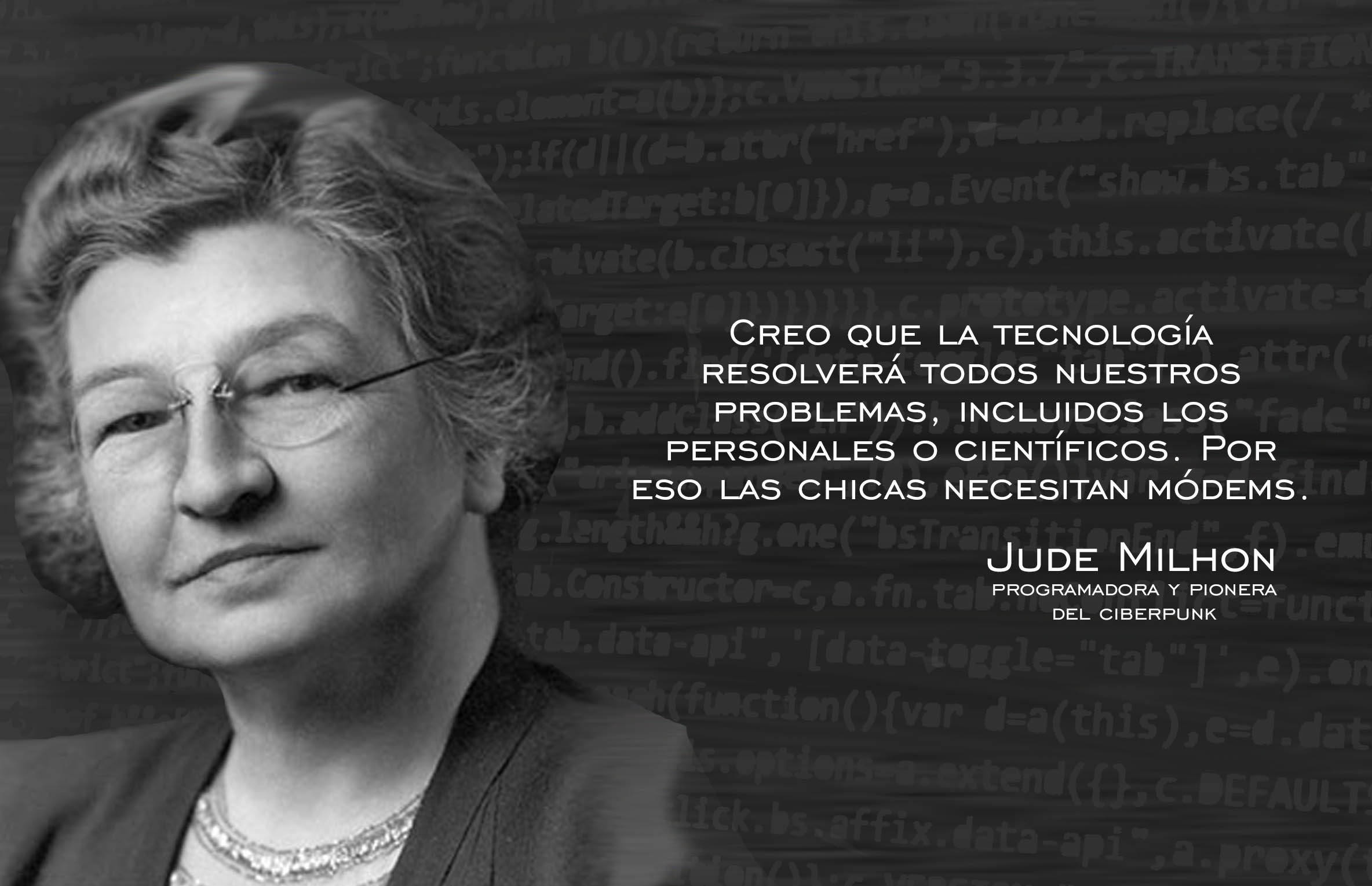
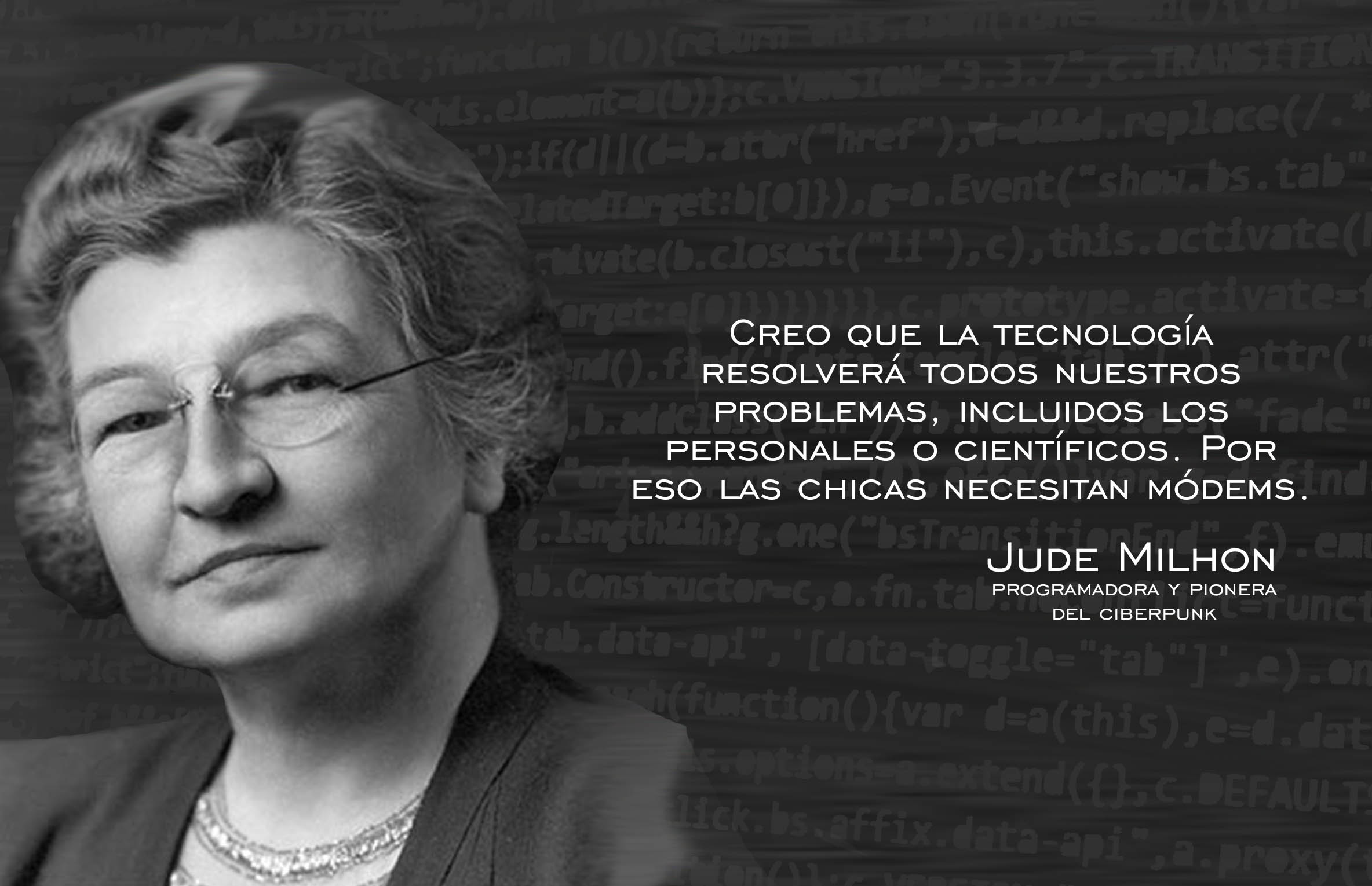
Jude Milhon, known in hacker culture as “St. Jude”, was a self-taught programmer, writer, editor, civil-rights advocate, and outspoken supporter of women participating directly in computing. Her career connects several important moments in Bay Area digital culture, from Community Memory in the 1970s to the early cypherpunk scene and Mondo 2000 decades later.
Her historical significance does not depend on having invented a programming language or a technology now used by billions of devices. Milhon represents another part of computing history: the people who asked who should have access to computers, what networks could be used for, and who had the right to participate in digital culture.
From civil-rights activism to programming
The Computer History Museum states that Milhon was born in 1939 and describes her as a self-taught programmer, civil-rights advocate, and supporter of women in computing.
In a 1995 Wired interview, Milhon said she had been programming since 1967 and had taught herself FORTRAN and assembly language. Wired later reported that she began programming for Horn & Hardart in Manhattan after teaching herself FORTRAN.
That combination of programming and social activism helps explain the rest of her career. For Milhon, learning to use computers was not simply a professional skill. It also meant gaining control of a technology that was still largely concentrated in governments, universities, and large corporations.
Community Memory: computers for the public
Milhon’s best-documented historical contribution is her work on Community Memory. The Computer History Museum identifies Lee Felsenstein, Efrem Lipkin, Ken Colstad, Jude Milhon, and Mark Szpakowski as the original founders, working with Resource One in the early 1970s.
In 1973, the group put a public system into operation in Berkeley that allowed people without technical training to read and post messages from a terminal connected to a time-shared computer.
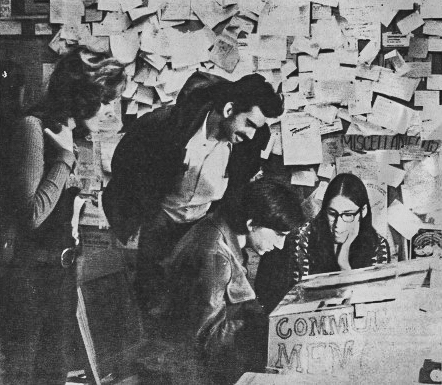
The best-known early installation was at Leopold’s Records, a record store in Berkeley. The terminal itself was an ASR-33 teletype connected remotely to the computer running the service. For the people using it, the important point was not the underlying architecture. It was the ability to walk up to a public machine and use it like an electronic community bulletin board.
What could people do with Community Memory?
Users could read and post messages, classified ads, and local information. The Computer History Museum documents musicians using the system to announce concerts, sell instruments, and find collaborators, while other users posted housing information, services, requests, events, and community discussions.
This was happening in 1973, decades before the Web and at a time when direct access to a computer was still unusual for most people.
Calling Community Memory “the first social network” is tempting but misleading. It was far more limited than a modern social platform. Its real importance is that it demonstrated a foundational idea very early: a networked computer could become a public space where users themselves created and exchanged information.
The philosophy behind Community Memory
Community Memory was not merely a technical experiment. Its founders were connected to counterculture, free-speech activism, and a decentralized view of technology.
Historical material preserved by the Computer History Museum shows that the project emphasized person-to-person communication and community control. At a time when computers were widely associated with institutional power, giving ordinary people direct access to one was itself a political and cultural statement.
The questions raised by Community Memory remain familiar today: should networks primarily distribute information from centralized institutions, or should communities also be able to use them as shared spaces they control and shape themselves?
“Girls need modems!”
Milhon devoted a significant part of her writing and activism to encouraging women to participate directly in computing and network culture.
The Computer History Museum preserves material from her “Girls need modems!” campaign, and the same phrase appears in her 1995 Wired interview.
Her approach was intentionally provocative. Rather than presenting technology as something that needed to be simplified for women, she argued that women should enter networks, programming, and hacker culture directly, experiment for themselves, and build technical confidence.
Some of Milhon’s 1990s views about conflict and behavior in online communities can sound abrasive or controversial today. A careful biography does not need to turn every historical opinion into current advice. The important point is that she was arguing for women’s direct participation at a time when connected computing culture was still overwhelmingly male.
Why “St. Jude”?
Milhon used St. Jude as a name in hacker and publishing circles. The nickname appears in contemporary interviews, articles, and archival material.
She was later affectionately described as a kind of “patron saint of hackers,” particularly after her death. That phrase is best understood as part of the humor and culture around her rather than as a literal title.
The birth of the cypherpunks
In the early 1990s, a Bay Area group began meeting around the relationship between cryptography, privacy, free expression, and government power. Eric Hughes, Timothy C. May, and John Gilmore were among the central organizers of the earliest meetings.
Milhon was part of that environment from the beginning. In the 1995 Wired interview she is described as an early member of the group and as the person who coined the word “cypherpunk”, combining cipher with cyberpunk.
This attribution is not merely a later legend. It appears in contemporary 1990s sources and was repeated by Wired in its 2003 obituary for Milhon.
What did “cypherpunk” mean?
The early cypherpunks shared an interest in practical uses of strong cryptography to protect privacy, communication, and individual autonomy on digital networks, although the group contained substantial political and philosophical disagreements.
The Cypherpunks mailing list became an influential forum for technical and political discussions about cryptography, anonymity, digital identity, electronic cash, surveillance, and free expression.
Milhon’s contribution to that culture was primarily through hacker culture, writing, and intellectual provocation. Her role should not be confused with the work of cryptographers who designed particular algorithms or protocols.
Milhon did not “invent” Tor, PGP, or Bitcoin
This distinction matters. Cypherpunk culture influenced the broader intellectual environment in which many privacy, cryptography, and decentralization projects developed.
But it is historically inaccurate to draw a simple line claiming that Jude Milhon—or “the cypherpunks” as one undifferentiated group—directly created PGP, Tor, blockchain, or Bitcoin. Each of those projects has its own authors, timeline, design goals, and technical ancestry.
Milhon’s documented contribution is important enough without exaggeration: she participated in the movement’s early circles and coined the name by which the movement became known.
Mondo 2000 and cyberculture
Milhon was also closely associated with Mondo 2000, a magazine that mixed computers, virtual reality, science fiction, art, music, psychedelics, and hacker culture with a deliberately irreverent style.
Wired documents that Milhon joined the publication in 1988 when it was still called Reality Hackers, and she later served as a senior editor at Mondo 2000.
The magazine belongs to a very specific historical moment: the years just before Internet access and the Web became mainstream. Its historical value lies partly in the way it tried to imagine a digital culture before much of that culture became ordinary.
Books and writing
Milhon wrote or co-wrote several works connected to hacking and cyberculture. The best-documented titles include The Cyberpunk Handbook, created with R. U. Sirius and Bart Nagel, and How to Mutate and Take Over the World, co-written with R. U. Sirius.
Her Hacking the Wetware: The NerdGirl’s Pillow Book also circulated online and was later associated with the title The Joy of Hacker Sex. These were not conventional technical manuals. They reflected Milhon’s tendency to combine technology, sexuality, hacker culture, humor, and social criticism.
What did Milhon mean by “hacking”?
Milhon’s idea of hacking was broader than unauthorized access to a computer system. In statements reported by Wired, she described hacking as creatively working around imposed limits, whether those limits were technical, political, or personal.
That definition is consistent with the older hacker tradition in which the word describes curiosity, exploration, deep understanding of systems, and clever problem-solving, even though popular usage later narrowed “hacker” toward computer intrusion.
Death and legacy
Jude Milhon died of cancer on July 19, 2003, according to Wired.
Reducing her legacy to one label would miss what makes her historically interesting. She was a self-taught programmer when direct computer access was rare, helped build an early public networked communication system, pushed women toward active participation in computing, wrote from the center of countercultural technology publishing, and was present at the creation of the cypherpunk identity.
Community Memory may be the clearest thread connecting all of those parts of her life: the belief that a connected computer did not have to belong only to specialists or institutions. It could also be a tool that ordinary people and communities used for themselves.
Sources and references
- Computer History Museum — Jude Milhon, Community Memory, and Girls Need Modems
- Computer History Museum — Community Memory: Precedents in Social Media and Movements
- Computer History Museum — Guide to the Community Memory records
- Wired, 1995 — Modem Grrrl: interview with Jude Milhon
- Wired, 2003 — Hackers Lose a Patron Saint
- Wired — history of Mondo 2000
- Wikimedia Commons — Community Memory terminal, 1973 (CC BY-SA 2.5)
This article is part of our series about people who helped build modern computing.