Delphi is an integrated development environment (IDE) and rapid application development (RAD) platform built around the Delphi language, a direct descendant of Object Pascal. More than three decades after its first release, its core idea remains recognizable: visually design user interfaces, write event-driven and business logic in a compiled strongly typed language, reuse components, and produce native applications with an integrated toolchain.
Update note (October 2026): this article was originally published in 2024. Since then Delphi has moved from the 12 Athens family to Delphi 13.2 Florence, the current commercial release published on September 17, 2026. We updated supported platforms, editions, Community Edition, VCL/FireMonkey, Linux, Windows on Arm, and the release timeline while preserving the original screenshots.
What exactly is Delphi?
The word “Delphi” can refer to three closely related things: the Delphi/Object Pascal language, the Delphi IDE, and the commercial Delphi product that is also included in RAD Studio. RAD Studio combines Delphi and C++Builder in one environment, while Delphi can also be licensed separately.

The screenshot above shows an older IDE generation —Delphi 11— and is intentionally kept because it illustrates Delphi’s workflow well: source editor, visual form designer, Object Inspector, component palette, debugger, and project management in one environment. In Delphi 13 Florence, Embarcadero also introduced a native 64-bit IDE, alongside the traditional 32-bit IDE for scenarios and targets that still require it.
The Delphi language and its Object Pascal roots
The language used by Delphi evolved from Object Pascal, while current Embarcadero documentation generally calls it the Delphi language. It retains Pascal’s readable syntax and strong typing but has long since moved beyond “Pascal with objects.” The language includes classes, interfaces, exceptions, generics, anonymous methods, extended RTTI, attributes, operator overloading, memory-management facilities, multithreading, and many other modern features.
Delphi compiles to native code for its supported targets. That can deliver good performance, fast startup, and relatively simple deployment, particularly on Windows. It is still misleading to claim that every Delphi application will automatically perform exactly like an equivalent C or C++ program: performance depends on algorithms, libraries, compiler behavior, platform, and code quality.
VCL and FireMonkey: Delphi’s two major visual frameworks
One of Delphi’s historic strengths is component-based development. A component can represent anything from a button or grid to a database connection, HTTP client, timer, or background service. The IDE lets developers configure properties and events visually, while the same functionality remains available in code.

VCL: native Windows applications
VCL (Visual Component Library) is Delphi’s long-established Windows framework. It integrates deeply with the Windows API and Windows controls and remains one of the strongest reasons to choose Delphi when building or maintaining native Windows desktop software. VCL supports 32-bit and 64-bit Windows and, in the Florence family, is also part of Delphi’s Windows on Arm support.
FireMonkey (FMX): cross-platform desktop and mobile
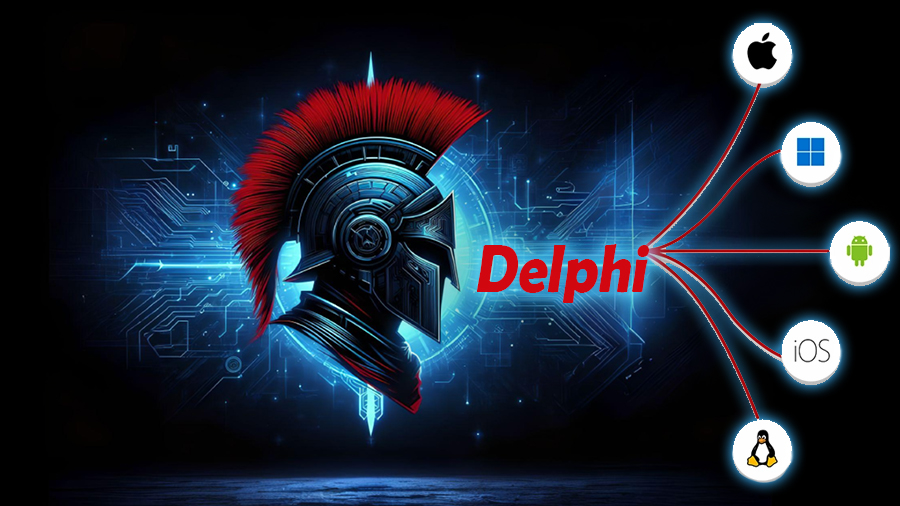
FireMonkey (FMX) debuted with Delphi XE2 in 2011 and is designed to share a large portion of application code and UI across platforms. Delphi currently targets FMX applications to Windows, macOS, iOS, and Android. A shared codebase does not mean every platform should look or behave identically: UI conventions, permissions, hardware, and OS APIs still require platform-specific decisions.
On Linux, two different capabilities must be distinguished. Delphi provides a Linux x64 compiler and RTL, especially useful for server-side and non-GUI applications in editions that include that target. Graphical FireMonkey applications on Linux use FMXLinux, installed through GetIt; Linux GUI support should not be described as identical to the built-in FMX support for Windows, macOS, iOS, or Android.
Supported platforms in Delphi 13.2 Florence
The Florence family currently supports Delphi development across several operating systems and CPU architectures. Embarcadero documents targets including:
- Windows: 32-bit, 64-bit, and Windows on Arm in supported configurations.
- macOS: Intel 64-bit and Apple Silicon/Arm 64-bit.
- iOS: 64-bit Arm devices.
- Android: 32-bit and 64-bit Arm targets for supported Android versions.
- Linux: Intel 64-bit for Delphi applications; FMX graphical UI on Linux is provided through FMXLinux.
Exact OS and SDK support changes with each RAD Studio release and with Apple, Google, Microsoft, and Linux distribution updates. For new projects, always check the official Florence supported target platforms page instead of assuming that an old IDE version will indefinitely support new operating systems.
What can you build with Delphi?
Delphi is not limited to desktop forms. Depending on edition, libraries, and target platform, it can be used for:
- Native Windows desktop applications with VCL or FireMonkey.
- Cross-platform Windows, macOS, iOS, and Android applications with FireMonkey.
- Console programs and command-line tools.
- Windows services and server processes.
- DLLs, packages, libraries, and reusable components.
- Network clients and servers, REST APIs, and HTTP services.
- Database-driven enterprise applications using FireDAC.
- Linux backend, service, and non-GUI workloads.
- Applications that consume REST, JSON, OAuth, cloud services, and third-party APIs.
Databases and FireDAC
Delphi has a long history in business and database software. Its central data-access library today is FireDAC. FireDAC can work with engines such as InterBase, SQLite, MySQL, PostgreSQL, SQL Server, Oracle, and others, but available connectivity depends on the Delphi edition. Community and Professional focus on local or embedded databases, while Enterprise and Architect add broader remote and enterprise database connectivity.
This also corrects a common claim found in older Delphi articles: that Delphi can “connect to any database in 60 seconds without writing code.” Visual designers can make connection setup and data binding extremely fast, but production software still needs to handle credentials, transactions, failures, concurrency, security, migrations, and a sound data-access architecture.
Why is Delphi still relevant in 2026?
- RAD productivity: visual designers, components, and event wiring still make UI development and prototyping fast.
- VCL remains excellent for Windows: particularly for business applications, utilities, internal tools, and modernization of long-lived software.
- Native compilation and straightforward deployment: many applications can ship without a managed virtual machine or large external runtime.
- Code continuity: Embarcadero continues to prioritize migration of older Delphi projects to current releases, which matters to companies maintaining decades of business logic.
- Strong component ecosystem: commercial and open-source libraries cover UI, reporting, communications, databases, cryptography, protocols, and many specialized domains.
- One language across several targets: substantial business logic can be shared between desktop, mobile, and server applications.
What are Delphi’s limitations?
Delphi also has trade-offs. Its job market and community are smaller than those around JavaScript/TypeScript, Java, C#, Python, or C++. Many modern libraries appear first in other ecosystems, and commercial Delphi editions have licensing costs that need to be considered in project budgets.
Cross-platform development also does not remove operating-system differences. A Windows application that depends on COM, Windows-specific APIs, device drivers, or VCL controls does not become portable simply by recompiling it. Clean separation between business logic, data access, platform services, and user interface remains important.
Delphi Community Edition: what it includes and where the limits are
For learning and personal projects, Embarcadero provides Delphi Community Edition (CE). At the time of this revision, Delphi 13 Community Edition is available. CE includes the IDE, compiler, debugger, VCL/FMX designers, components, and support for building Windows, macOS, iOS, and Android applications.
Community Edition is not a trial. It has a limited commercial-use license. Embarcadero’s current FAQ states a US$5,000 annual revenue threshold for covered scenarios and also imposes team-size and organizational-use restrictions. If a project no longer qualifies, a paid commercial edition is required. Anyone using CE for paid work should read the current EULA rather than relying only on a summary.
A useful 2026 distinction is that Community Edition is based on Delphi 13 Florence, while the commercial branch has already advanced to 13.2 Florence. CE also does not include Kai, Embarcadero’s AI coding assistant.
Official Delphi Community Edition page · Official Delphi CE download
Commercial Delphi editions
Embarcadero currently offers four main Delphi editions:
| Community | Learning, individual developers, and projects that remain within the CE commercial-use restrictions. |
| Professional | Commercial desktop and mobile development with local/embedded database capabilities. |
| Enterprise | Adds remote database connectivity, Linux development, RAD Server, and features for client/server and multi-tier applications. |
| Architect | Adds tools and licenses aimed at enterprise architecture and advanced data modeling. |
The exact feature matrix changes between releases, so purchase decisions should be based on the current official Delphi editions comparison.
History and evolution: the milestones that matter
Borland released Delphi 1 on February 14, 1995 for Windows 3.1. Its combination of native compilation, two-way visual design, VCL, and database tooling made it one of the defining RAD products of the 1990s. The Delphi name survived the Borland and CodeGear eras and later continued under Embarcadero.
Instead of a long year-by-year list that mixes product naming with actual release dates, the major technical milestones are more useful:
| 1995 — Delphi 1 | Visual RAD, VCL, and 16-bit Windows development. |
| 1996 — Delphi 2 | Move to 32-bit Windows. |
| 2002 — Delphi 7 | One of the most widely adopted classic Delphi releases. |
| 2008 — Delphi 2009 | Unicode, generics, and anonymous methods. |
| 2011 — Delphi XE2 | 64-bit Windows, macOS, and the first FireMonkey generation. |
| 2013 — XE4/XE5 | iOS, FireDAC, and then Android support. |
| 2021 — Delphi 11 Alexandria | A new IDE generation with updated platform support. |
| 2023 — Delphi 12 Athens | Further language, compiler, VCL, FMX, and tooling evolution. |
| 2025 — Delphi 13 Florence | Native 64-bit IDE, new Delphi language features, and broad platform modernization. |
| 2026 — Delphi 13.2 Florence | Faster compilers, LLVM 20 for Linux, Arm improvements, VCL/FMX enhancements, productivity work, and AI integration options. |
Delphi 13.2 Florence: what changed recently
The current commercial release, Delphi 13.2 Florence, continues the modernization that began with Delphi 13. The Florence family brings a native 64-bit IDE, Windows on Arm support, compiler work, continued VCL and FireMonkey development, and additional IDE productivity improvements.
In 13.2, Embarcadero also moved the Delphi Linux Intel 64-bit compiler and toolchain to LLVM 20 and announced compilation-performance improvements, expanded Linux and Windows on Arm work, updated Android/iOS support, and tools for connecting Delphi applications to AI services. Those AI features are optional; Delphi remains a traditional IDE, compiler, and application framework that can be used without them.
Is Delphi worth learning today?
Yes, in the right context. Delphi is particularly valuable if you work with existing Windows applications, business software, internal tools, database-heavy systems, long-lived products, or organizations that already own a Delphi codebase. It is also a good environment for learning object-oriented, event-driven, and component-based desktop development.
If your main goal is maximizing entry-level job opportunities, working exclusively in modern web frontend, or using the broadest machine-learning ecosystem, C#, JavaScript/TypeScript, Java, or Python may provide a more direct path. Delphi does not need to be “the best language” to remain highly productive in the domains where it fits well.
Official resources and community
- Delphi — official Embarcadero site.
- Official Delphi Language Reference — Florence.
- RAD Studio Florence supported target platforms.
- Official Delphi innovation timeline.
- LearnDelphi.org.
- Club Delphi.
- Delphi desde Cero.
- Embarcadero Technologies on YouTube.
Conclusion
Delphi has changed dramatically since Delphi 1 in 1995, but the idea that made it successful is still intact: reduce the distance between designing an application and having a working native program. In 2026 it remains especially compelling for Windows, enterprise software, and mature codebases, while its continuing work on Arm, Linux, macOS, and mobile platforms shows that it is not simply a technology frozen in the 1990s.
If you want to explore Delphi without buying a commercial license, Community Edition is a practical entry point as long as you comply with its licensing terms. For professional projects, compare editions and identify required target platforms, databases, and deployment features before choosing a license.